Alilance Environmental operates within one of the most comprehensive regulatory environments in the nation, and knowing exactly who regulates what can mean the difference between smooth project completion and costly stop-work orders.
LA-area commercial renovations involving asbestos are governed by a stack of rules—federal NESHAP (EPA), state Cal/OSHA §1529, and South Coast AQMD Rule 1403, plus LADBS permit notifications for demolition and alteration projects. Think of asbestos compliance like air-traffic control for your jobsite: strict checklists, precise sequencing, and zero improvisation. Your general contractor opens a soffit on a 1970s floor during tenant improvement work; activity stops immediately; tenants start asking questions; you need a compliant path forward today to avoid cascading delays and mounting costs. The practical response? Start with a Rule 1403 survey and notification, align controls with Cal/OSHA §1529 work practices, verify NESHAP applicability, and ensure LADBS documentation is ready before any material disturbance begins.
For facility managers and property directors overseeing commercial renovations in Los Angeles, understanding this regulatory framework isn’t optional—it’s the foundation that protects project timelines, budgets, and organizational liability.
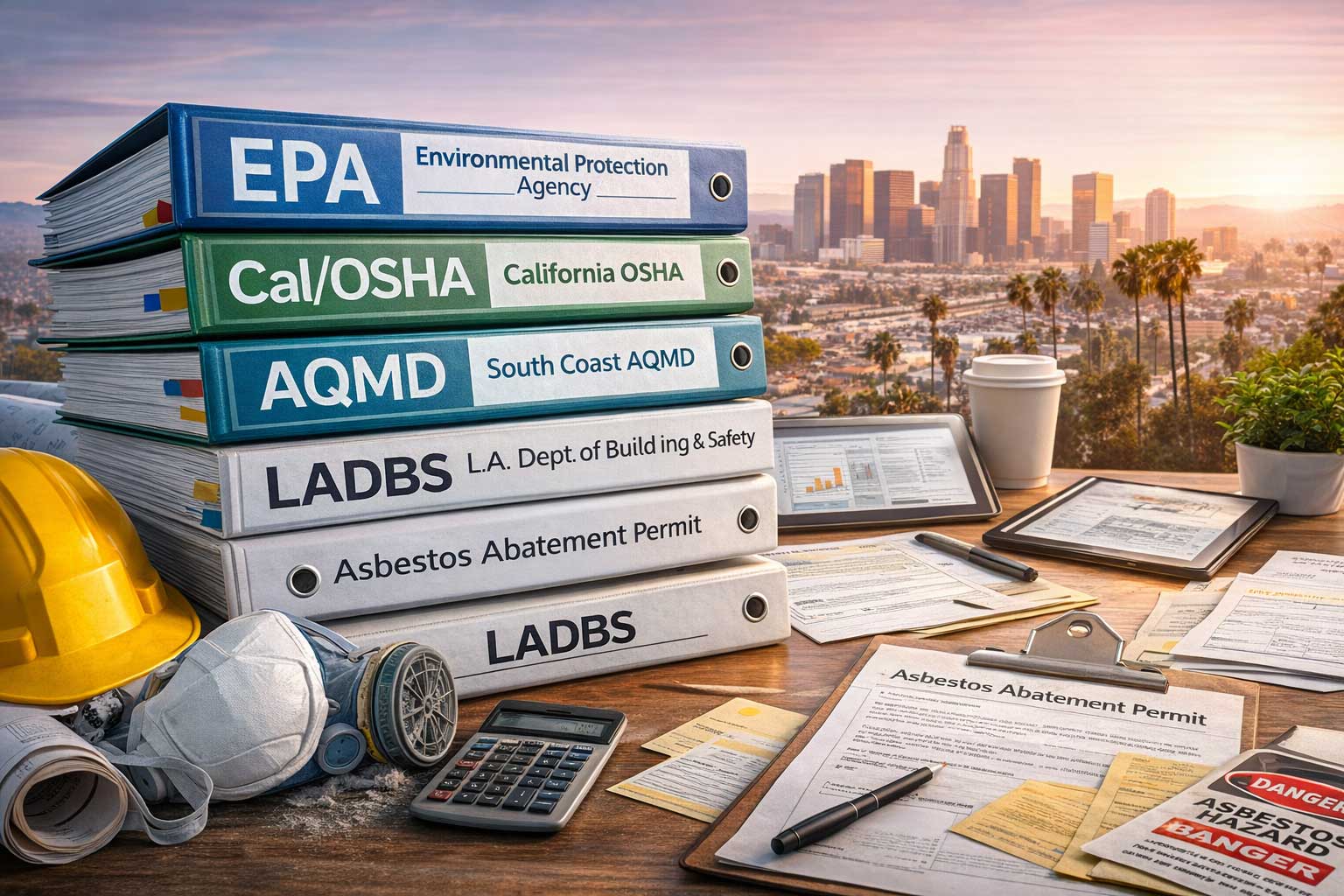
The Compliance Stack in LA (EPA → Cal/OSHA → AQMD → LADBS)
Multiple agencies regulate different aspects of asbestos removal in Los Angeles, creating a compliance framework that functions much like air-traffic control—each level has specific responsibilities and must be cleared in sequence.
What NESHAP Covers (Federal)
The Environmental Protection Agency’s National Emission Standards for Hazardous Air Pollutants (NESHAP), specifically 40 CFR Part 61 Subpart M, establishes federal baseline requirements for asbestos projects. NESHAP defines regulated asbestos-containing materials (RACM), sets notification thresholds for large-scale demolition and renovation work, and mandates specific waste handling and disposal standards. These federal rules apply throughout Los Angeles and establish minimum requirements that state and local agencies often expand upon.
What Cal/OSHA §1529 Requires On Site (State)
California’s Occupational Safety and Health Administration enforces Title 8 §1529, the construction standard for asbestos work. This regulation governs how work is actually performed on your jobsite and includes:
- Work classification systems (Class I through IV) that determine required controls
- Negative pressure containment requirements for higher-risk activities
- Respiratory protection programs and fit testing
- Competent person designation and oversight
- Worker training and medical surveillance programs
- Exposure monitoring and record-keeping obligations
Cal/OSHA §1529 applies to demolition, renovation, asbestos spill cleanup, material transportation, and housekeeping activities on construction sites. Your contractors must demonstrate compliance with these standards throughout the project lifecycle.
When Rule 1403 Applies, Who Files, and When (Regional)
South Coast Air Quality Management District (AQMD) Rule 1403 is perhaps the most frequently referenced regulation for asbestos removal in Los Angeles projects. This regional rule requires:
- Asbestos surveys conducted by qualified personnel before demolition or renovation activities
- Electronic notification submitted through AQMD’s web portal
- Work practices designed to minimize asbestos emissions during material disturbance
The notification timing varies by project type. For demolition projects or removal of more than 100 square feet of intact asbestos-containing material (greater than 1% asbestos content), a typical 10-working-day advance notice is required. However, smaller removals and emergency situations have different timelines. The current AQMD Rule 1403 FAQ provides specific guidance on notification thresholds, and checking this official resource before each project prevents compliance gaps.
Rule 1403 also specifies who can perform surveys—only individuals meeting California’s asbestos consultant certification (CAC) requirements or equivalent qualifications can conduct compliant surveys in the AQMD jurisdiction.
LADBS Permit Checkpoints You Can’t Miss (City)
The Los Angeles Department of Building and Safety (LADBS) adds a critical layer: the permit gate. Under California Health and Safety Code §19827.5, LADBS cannot issue demolition or alteration permits until proper asbestos notification documentation is provided. LADBS Information Bulletin P/BC 2014-067 reinforces this requirement.
This checkpoint creates a hard stop in your project timeline if asbestos compliance isn’t addressed early. Build LADBS notification proof into your pre-construction checklist, and coordinate AQMD notification timing with your permit application schedule to avoid delays.
Your 1-Page Sequence to Stay Compliant
Just as air-traffic control follows precise protocols to keep aircraft safely separated, your asbestos removal in Los Angeles project requires a specific sequence to maintain compliance across all regulatory layers.
| Step | Agency/Rule | What You Do | When | Proof You Keep |
|---|---|---|---|---|
| 1. Survey | AQMD Rule 1403 | Retain CAC-certified professional to inspect and sample materials | Before any scope development or bidding | Survey report with sample results, inspector credentials |
| 2. Notify | AQMD Rule 1403 | Submit electronic notification via AQMD portal; attach survey | Typically 10 working days before work (check FAQ for your scenario) | Notification confirmation receipt, submission timestamp |
| 3. Permit Documentation | LADBS / HSC §19827.5 | Provide AQMD notification proof to LADBS with permit application | Before permit issuance | Permit application package, LADBS approval |
| 4. Work Controls | Cal/OSHA §1529 | Implement containment, negative air, PPE, competent person oversight | Throughout active abatement/disturbance | Daily logs, air monitoring records, competent person documentation |
| 5. Disposal | EPA NESHAP | Package and transport RACM to approved facility; obtain manifest | At project completion | Signed waste manifests, transporter/landfill documentation |
| 6. Close-Out | All agencies | Compile compliance documentation packet | Before final inspection or tenant reoccupancy | Complete file: survey, notification, permits, logs, manifests |
Core Actions for Property Managers
Translating regulations into operational steps is essential for facility managers who need to act quickly when asbestos is discovered or suspected.
- Survey First, Every Time
A Rule 1403 asbestos survey is required before renovation or demolition work in the South Coast Air Basin.
Retain a Cal/OSHA-credentialed professional to conduct the survey before developing your scope of work or soliciting contractor bids. Keep the survey report on file for all notifications and include it in bid packages so contractors can price appropriate controls. Never assume materials are asbestos-free based on age or appearance alone.
- File the Right Notifications
Submit AQMD Rule 1403 electronic notification within required lead times—commonly 10 working days for demolition or certain removal activities.
Use AQMD’s official web notification portal. Align notification timing with your general contractor’s schedule and your permit application timeline. Attach the survey report to your notification. If your project also requires LADBS permits, coordinate both submissions to prevent delays.
- Run Cal/OSHA-Compliant Controls
Follow Title 8 §1529 construction standards, including containment, negative air systems, personal protective equipment, competent person designation, and clearances where applicable.
Build these specific controls into your scope of work and pre-task planning documents. Verify that your contractor’s personnel have completed required training and medical surveillance programs. Don’t accept generic “safety plan” language—require explicit §1529 compliance documentation.
- Meet NESHAP Disposal and Handling Rules
RACM handling, packaging, labeling, and disposal must meet federal NESHAP requirements.
Ensure your waste transporter and receiving landfill are approved to accept asbestos-containing materials. Retain all waste manifests with signatures from generators, transporters, and disposal facilities. These manifests are essential compliance proof and may be requested during future transactions or tenant due diligence.
- Document, Then Close Out
Maintain notification receipts, survey reports, daily work logs, air monitoring records (if performed), and disposal manifests in a comprehensive compliance file.
Create a “Compliance & Safety Documentation Packet” for each project. This file protects ownership, satisfies insurance requirements, provides documentation for future tenants, and demonstrates due diligence if questions arise years later.
Key LA-Area Nuances
Understanding local variations within the broader regulatory framework accelerates compliance and prevents common mistakes.
The AQMD Rule 1403 FAQ clarifies when 10-working-day notices are required, when shorter emergency timelines apply, and when projects under specific thresholds (such as removals under 100 square feet of intact ACM) may not require notification—though other Rule 1403 requirements still apply. Always reference the current official FAQ rather than outdated summaries, as thresholds and procedures are updated periodically.
Demolition permit issuance is contingent on asbestos notification proof under HSC §19827.5. This isn’t a suggestion—it’s a hard requirement that blocks permit approval. Build this checkpoint into your critical path schedule and pre-construction checklist.
AQMD offers Rule 1403 training programs for stakeholders. Working with vendors who maintain current training and stay engaged with AQMD updates reduces your risk exposure. Ask potential contractors when they last completed AQMD training and request proof of certification.
LA County Department of Public Health emphasizes that intact asbestos-containing materials don’t present a hazard until disturbed. This framing is valuable when communicating with tenants and building occupants—the focus should be on proactive survey, professional containment, and controlled removal rather than alarm.
Common Pitfalls That Trigger Delays and Fines
Myth: “Any demolition contractor can handle asbestos.”
Fact: Cal/OSHA §1529 and AQMD Rule 1403 require specific credentials, notifications, and work practice controls. A general demolition license doesn’t automatically qualify a contractor for asbestos work. Cutting corners by using unqualified contractors risks immediate stop-work orders, significant fines from multiple agencies, and liability exposure that can extend to property ownership. Verify contractor credentials before work begins, not after a violation occurs.
Why Compliance-First Beats Cut-Rate Bids
Some property managers face pressure to accept the lowest bid for asbestos removal in Los Angeles projects. However, contractors who underbid typically cut corners on required notifications, surveys, containment systems, or disposal procedures. When AQMD or Cal/OSHA issues violations, the resulting fines, work stoppages, and schedule delays cost far more than the initial “savings.” Over-compliance doesn’t slow projects—it prevents expensive rework and regulatory shutdowns.
Tenant-Safe Communication
When asbestos work becomes necessary, facility managers must balance transparency with appropriate context to avoid unnecessary alarm.
Use LA County Department of Public Health framing: intact asbestos-containing materials don’t pose health risks until they’re disturbed. Emphasize what you’re doing proactively—conducting surveys, implementing containment, maintaining negative air pressure, and performing air monitoring—rather than focusing on hypothetical dangers.
Sample tenant communication: “We’ve identified materials in [location] that require specialized handling during our renovation. We’ve retained certified professionals to perform a controlled removal using containment barriers and air filtration systems. All work follows EPA, Cal/OSHA, and AQMD requirements. The affected area will remain isolated throughout the process, and we’ll provide clearance documentation before reopening.”
When to Call In Specialists
Some projects require specialist intervention from the start. Consider bringing in professional asbestos removal in Los Angeles firms when:
- Survey results show extensive ACM across multiple building systems
- Renovation timelines are compressed and regulatory coordination is complex
- Tenant-occupied spaces require sophisticated containment and air management
- Previous contractors have left compliance gaps that need remediation
Vendor Vetting Checklist Aligned to LA Rules
Ask prospective contractors these specific questions:
- “Do you hold current California asbestos contractor certification?”
- “When did your team last complete AQMD Rule 1403 training?”
- “Can you provide examples of AQMD notifications you’ve filed in the past 12 months?”
- “How do you ensure Cal/OSHA §1529 competent person requirements on every job?”
- “What documentation will you provide at project completion?” (Expect: notification receipts, work logs, air monitoring results, waste manifests)
- “Which licensed disposal facilities do you use, and can you provide pre-approval documentation?”
Firms with proven AQMD notification experience and demonstrated Cal/OSHA compliance will answer these questions immediately and provide documentation. Hesitation or vague responses indicate risk.
Frequently Asked Questions
What asbestos notifications are required before renovation in Los Angeles?
Projects in the South Coast Air Basin require AQMD Rule 1403 electronic notification, typically filed 10 working days before demolition or removal of more than 100 square feet of intact asbestos material. LADBS also requires proof of this notification before issuing demolition or alteration permits.
Does Rule 1403 always require a 10-day notice?
No. The 10-working-day advance notice is common for demolition and larger removals, but emergency situations, smaller-scale removals, and certain project types have different timelines. Always consult the current AQMD Rule 1403 FAQ for your specific scenario to determine exact notification requirements.
How does Cal/OSHA §1529 change my contractor’s on-site controls?
Section 1529 mandates specific work practices based on the class of asbestos work being performed. This includes requirements for containment barriers, negative air pressure systems, personal protective equipment, respiratory protection programs, exposure monitoring, and designation of a competent person to oversee compliance. These aren’t optional enhancements—they’re enforceable standards.
Do I need an LADBS permit if only minor asbestos is present?
If your project involves demolition or alteration work that would normally require an LADBS permit, the permit is still required regardless of asbestos quantity. LADBS cannot issue these permits without asbestos notification documentation, even for minor asbestos quantities.
Who can legally perform an asbestos survey?
Only individuals meeting California’s asbestos consultant certification (CAC) requirements or equivalent AQMD-recognized qualifications can conduct compliant surveys in the South Coast Air Basin. Verify your surveyor’s credentials before work begins to ensure the survey will satisfy Rule 1403 requirements.
Ready to Navigate LA Asbestos Regulations With Confidence?
Understanding the regulatory framework is the first step. Executing compliant asbestos removal in Los Angeles requires experienced professionals who coordinate seamlessly across EPA, Cal/OSHA, AQMD, and LADBS requirements.
Alliance Environmental Group brings decades of experience navigating LA’s complex asbestos regulations for commercial properties. Our team handles survey coordination, notification filing, Cal/OSHA-compliant work practices, and complete documentation—so your renovation stays on schedule and fully compliant.
Take Action Now:
Call Now: (877) 899-9867 — Speak directly with our compliance specialists
References
[1] South Coast AQMD Rule 1403 – Asbestos Emissions from Demolition/Renovation Activities (aqmd.gov)
[2] eCFR 40 CFR Part 61 Subpart M (NESHAP Asbestos) (eCFR)
[3] Cal/OSHA Title 8 §1529 – Asbestos (Construction) (Cal DIR)
[4] LADBS — Asbestos Hazards & Permit Notification Guidance (IB P/BC 2014-067) (ladbs.org)
[5] AQMD Rule 1403 – Notification & FAQ (aqmd.gov)